
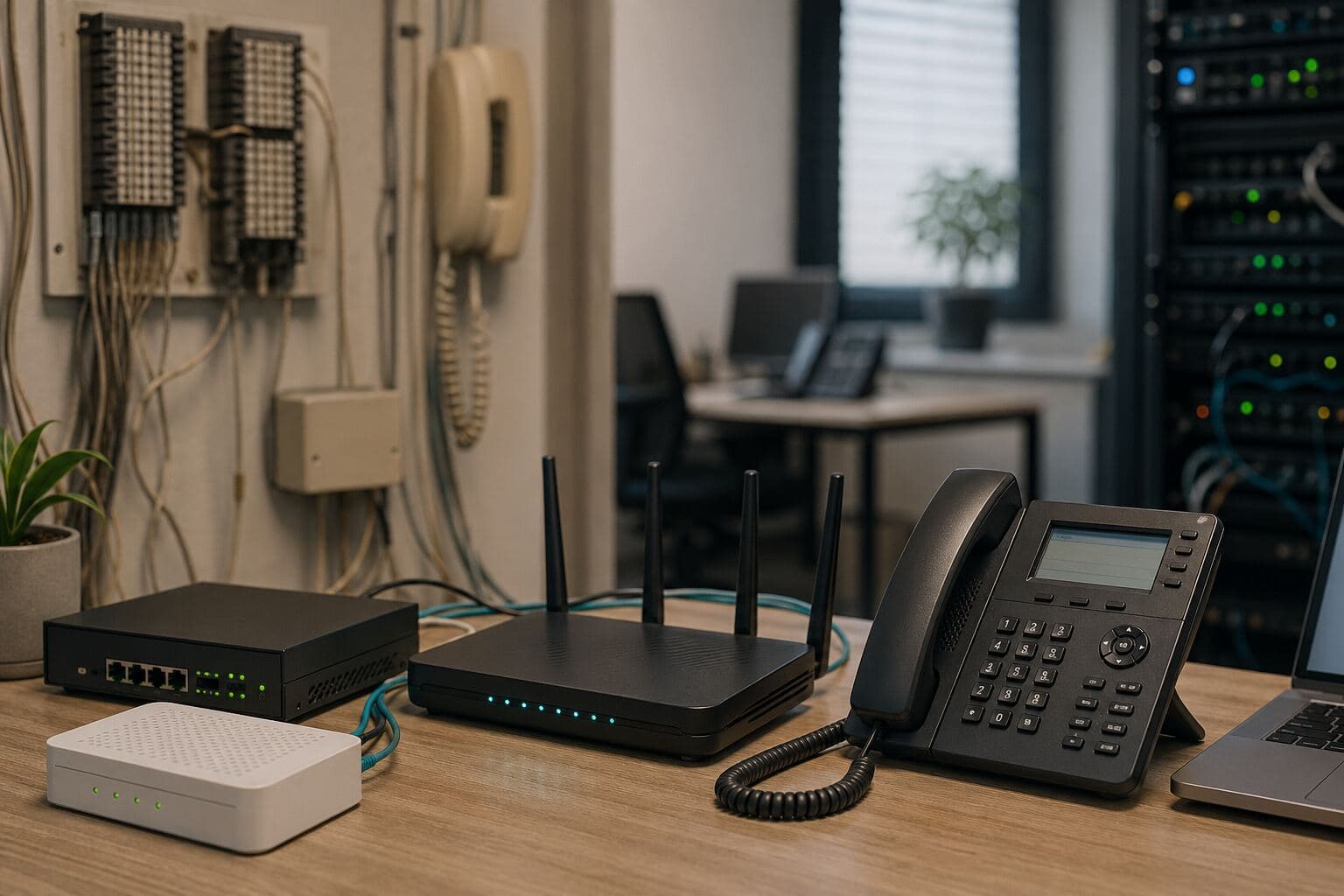
South Africa VoIP in 2026: copper decline, fibre growth and what it means for business
A 2026 industry update for South African businesses on the shift away from copper lines, the impact of fibre on VoIP quality, load shedding resilience, number porting, and buyer expectations for modern business telephony.
Quick answer
Last updated 2026-04-22
- A 2026 industry update for South African businesses on the shift away from copper lines, the impact of fibre on VoIP quality, load shedding resilience, number porting, and buyer expectations for modern business telephony.
- South Africa’s fixed-line market has moved decisively away from copper. Businesses that still rely on legacy analogue lines or ADSL are now exposed to a shrinking support base, ageing infrastructure and limited upgrade paths.
Copper is no longer the safe option
South Africa’s fixed-line market has moved decisively away from copper. Businesses that still rely on legacy analogue lines or ADSL are now exposed to a shrinking support base, ageing infrastructure and limited upgrade paths.
Telkom and other operators have continued migrating customers towards fibre, fixed wireless and mobile alternatives as copper networks become less viable to maintain. ADSL subscriber numbers have fallen sharply from their peak, while fixed-line voice revenue has continued to decline as businesses move to IP-based systems.
For business owners, the practical message is clear:
* Copper is no longer a future-proof communications platform.
* Fault repair and service continuity are likely to become harder over time.
* Keeping an old line “just in case” may create more operational risk than moving to a managed VoIP service.
The market has changed: VoIP is no longer the alternative. For many South African businesses, it is now the default.
Fibre has changed the VoIP quality conversation
A decade ago, many South African VoIP deployments were limited by the access network. Running voice over ADSL or unstable mobile links often meant jitter, delay, dropped calls and inconsistent user experience.
That picture has changed materially. Fibre-to-the-business and fibre-to-the-home coverage have expanded across metros, secondary cities and many smaller towns. Fixed broadband adoption continues to grow, giving more businesses access to stable, low-latency connectivity.
For VoIP, this matters more than headline download speed. Good call quality depends on:
* stable latency;
* sufficient upload capacity;
* low packet loss;
* correctly configured routers and firewalls;
* voice traffic prioritisation where required.
Modern fibre has made those conditions easier to achieve. For many offices, VoIP call quality is now consistently better than older analogue lines, provided the network is installed and managed correctly.
Where fibre is not available, LTE, fixed wireless and satellite connectivity can still play a useful role as a primary or failover path. The key is to design for business continuity, not just basic connectivity.
Load shedding has made resilience a buying requirement
Load shedding has changed how South African businesses think about communications. Traditional on-site PBX systems depend heavily on office power, local equipment and physical lines. When the site goes down, the phone system often goes down with it.
Cloud-based VoIP gives businesses more options. The platform can remain available even if one office loses power, while calls can be redirected to mobile apps, laptops, other branches or overflow numbers.
That does not remove the need for local planning. Desk phones, routers, fibre ONTs and Wi-Fi equipment still need power. A resilient VoIP setup should include:
* battery backup or an inverter for routers, ONTs and key phones;
* mobile app access for staff who work remotely;
* call forwarding rules for outages;
* failover connectivity where voice is business-critical;
* documented escalation steps for reception, sales and support teams.
The businesses getting the most value from VoIP in 2026 are not only replacing old phone lines. They are using VoIP to keep teams reachable during power cuts, site outages and hybrid work days.
Number porting still needs proper administration
Number portability remains an important part of South Africa’s voice market. Businesses can move numbers between providers, but the practical experience often depends on preparation.
Porting delays are commonly administrative rather than technical. Mismatched account details, missing authorisations or unclear number ownership can slow down an otherwise straightforward move.
Before starting a port, businesses should:
* assign an internal owner for the project;
* list every number, including fax, alarm, lift, gate, card machine and backup lines;
* confirm the legal account holder and authorised signatory;
* check that billing details match the current provider’s records;
* agree a cutover window and rollback plan;
* notify staff before any routing changes go live.
Complex number ranges or multi-site environments need more planning time. Treat porting as a project, not a formality.
Business buyers want integrated platforms
The South African VoIP market has matured. Buyers are no longer looking only for cheaper call rates or a replacement handset. They want systems that are easier to manage, secure by design and suitable for hybrid teams.
In 2026, common requirements include:
* One platform for multiple sites: Head office, branches and remote users should be managed from a central interface.
* Mobile and desktop access: Staff need to make and receive business calls away from their desks.
* Secure provisioning: Devices should be configured and controlled properly, with change management and access control.
* Standards-based hardware: Open, compatible systems reduce long-term support and replacement issues.
* Clear reporting: Management teams want visibility of call volumes, missed calls and user activity.
* Continuity planning: Routing rules should support outages, remote work and after-hours handling.
Security is also more prominent in buying decisions. Businesses should ask how their provider handles device provisioning, password policies, encryption options, administrator access and call routing changes.
Global growth is reinforcing the local shift
VoIP adoption is not only a South African trend. Globally, businesses are moving voice into broader cloud communications environments as remote work, mobile-first workflows and digital customer engagement become normal. [Source needed: current global VoIP market forecast and regional adoption data.]
For South African companies, the global trend matters because it influences product development, vendor investment and user expectations. Voice is becoming part of a wider communications stack that can include call recording, analytics, CRM integration, messaging and contact centre tools.
The result is a market where VoIP is no longer seen as a cost-cutting substitute for a landline. It is becoming core business infrastructure.
What this means for South African businesses
The direction of the market is clear in early 2026:
* Copper is declining and becoming harder to justify.
* Fibre and fixed wireless coverage are improving the reliability of VoIP.
* Load shedding has made flexible call routing and remote access essential.
* Number porting remains manageable when administration is handled properly.
* Buyers expect secure, integrated platforms rather than isolated hardware.
For businesses planning a communications refresh, the priority should be practical outcomes: fewer missed calls, better continuity, easier branch management and a system that can support hybrid work.
A successful VoIP project starts with clear requirements. Define what reception, sales, support, finance and management need from the system before choosing handsets or signing porting forms.
Final thought
Ten years ago, moving to VoIP in South Africa often required patience and compromise.
In 2026, the risk has shifted. Staying on legacy copper infrastructure can expose a business to declining support and limited resilience. A properly planned VoIP deployment, backed by reliable connectivity and power continuity, is now the more practical path for most South African businesses.
* /solutions/voip-business-telephony
* /blog/is-voip-reliable-during-load-shedding
* /contact